Before you fall in love with a wisteria or an ivy at the garden centre, ask one question: how does this plant actually climb? The answer determines whether it belongs on your brick wall, your wooden trellis, or your pergola. Climbing plants fall into two broad camps—self-clinging climbers that grip surfaces on their own, and twining climbers whose scrambling stems need something to wrap around. Choose the wrong type for your structure and you risk either a plant that fails to establish or a structure that suffers under its vigor. Here is how to get the match right.
Understanding Climbing Plant Mechanisms: Self-Clinging vs. Twining
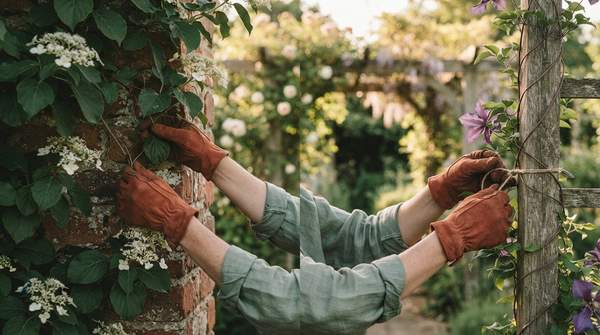
Every climber, whatever its personality, shares one trait: it can scale buildings, fences, obelisks, and trees, sometimes reaching great heights. Writing on climbing plants and houses, the Gardens, Heritage and Planning blog draws on Royal Horticultural Society guidance to make the key distinction. Twining climbers, in the RHS's words, "have scrambling stems that need a support, such as a trellis," while self-clinging climbers "can grow up vertical surfaces and supports unaided," using tendrils or stem roots.
That single difference drives everything else in this guide. A self-clinger brings its own gripping equipment—adhesive pads or aerial roots—so it can colonize a flat, solid surface. A twiner brings nothing but flexible stems that must spiral around something upright and open enough to encircle. Neither method is better; each is simply suited to a different architecture.
It is worth noting that some plants blur the line. Gardeners' World describes Japanese honeysuckle as a "vigorous, twiggy, self-clinging twining climber," combining both habits—a reminder that a plant's vigor and attachment style both matter when you plan a planting.