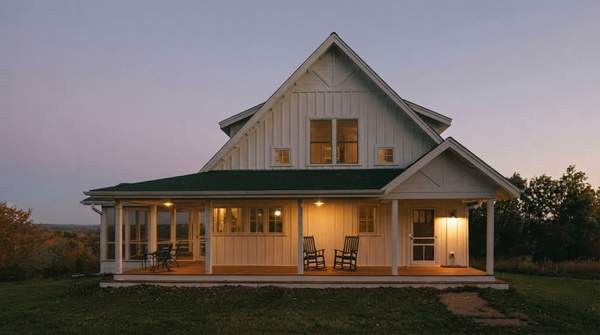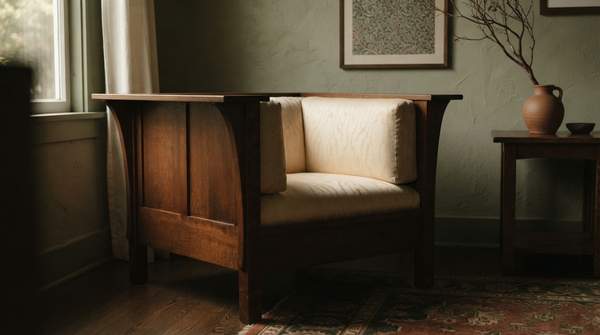
American Mission Style is easy to spot once you know what you are looking for, and almost everything comes down to three things: simplicity, craftsmanship, and natural materials. If a piece of furniture shows clean, straight, rectilinear lines, visible joinery, and solid wood—usually oak or cherry—left to speak for itself, you are almost certainly looking at Mission. If a room wraps thick wood trim around its windows, leans on built-ins and dark hardwood floors, and pairs it all with furniture that feels grounded and built to last, you are looking at a Mission interior. I have always found the style seductive precisely because it asks so little of the eye and gives so much back to the hand.
The Origins of American Mission Style: A Reaction to Excess
To understand why Mission furniture looks the way it does, you have to understand what it was pushing against. The style emerged from the Arts and Crafts movement, a philosophical revolt against two intertwined villains of the late nineteenth century: the overwrought ornamentation of the Victorian era and the flimsy, mass-produced furniture that rolled off Industrial Revolution assembly lines. Its answer was almost stubbornly plain—honest materials, handcrafted construction, and forms stripped down to function.
The name most attached to the American version is Gustav Stickley, the furniture maker who, as one design retailer's history puts it, popularized the style alongside other artisans "who believed in the value of handcrafted furniture and simple, functional designs." Stickley's own company, still making furniture in this tradition today, traces how the style spread across the United States, taking root especially in the Southwest and on the West Coast, where it sat comfortably among the bungalows and Craftsman-style homes of the era—houses with exposed wood beams, natural stone, and other natural materials.
One useful distinction before we go further, because the naming trips people up constantly: American Mission Style is not a guide to Spanish Colonial Mission architecture, the stucco-and-terracotta church style of the Southwest. They share a name and some earthy instincts, but the furniture-and-interiors style we are discussing here is a child of the Arts and Crafts movement. Keep them separate in your mind and you will avoid the most common mix-up in this whole corner of design history.