If your goal is a fireplace that reads as bold, ornate, and historically rich, the Victorian mantel is the classic American style most likely to deliver it. Design guidance from Fireside describes Victorian fireplaces as ones that "should be bold and ornate, incorporating carved details, decorative tiles, and rich materials such as marble," with an intricately designed surround adding "the opulent charm characteristic of the era." This guide breaks down what those characteristics look like, where they came from, and how to judge whether the style suits your home.
The Grandeur of Victorian Fireplace Mantels
Victorian mantels belong to the family of traditional fireplace surrounds that complement classic American home styles, a group that also includes Colonial, Craftsman, and Farmhouse. What separates the Victorian example from its neighbors is its appetite for ornament. Where traditional surrounds in general are described as featuring "rich materials, intricate detailing, and a sense of grandeur," the Victorian interpretation pushes each of those qualities toward their most elaborate expression.
That elaborateness is not incidental. It is the defining trait of the style, and it is what makes identification straightforward: if a mantel is carved, tiled, and layered with decorative detail rather than restrained and plain, you are most likely looking at Victorian influence rather than a Colonial or Craftsman counterpart.
Historical Roots: The Victorian Era's Design Philosophy
The style's exuberance has a practical origin. According to Old World Stoneworks' history of fireplace styles, new fuel sources like coal gained popularity in post-Civil War America, and iron stoves with stove pipes provided radiant heating throughout the home without the need for expansive chimneys. In that era, decorative mantels often served as backdrops for coal stoves rather than as the working heart of the hearth.
This changed what a mantel needed to be. Freed from purely functional demands, the fireplace became a stage set. Cast iron, in particular, was not only a practical choice for fireboxes but offered extensive potential for the intricate ornamentation popular in the era, especially for grates, surrounds, and other visible structures. The result, as Old World Stoneworks puts it, is that for many homeowners today this layered ornamentation is "the hallmark of an old school fireplace aesthetic."
Key Characteristics of Victorian Mantels
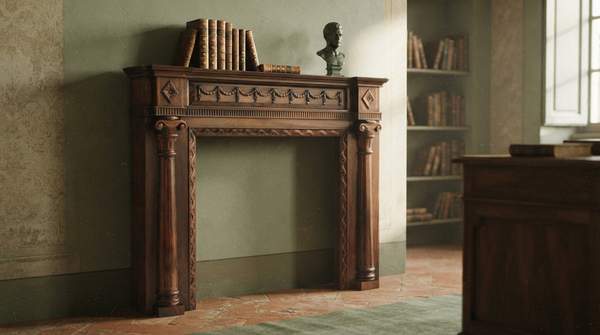
Three visual signatures recur across the design guidance. First, carved details: traditional mantels of this lineage often showcase carved wood, decorative moldings, or fluted columns, and the Victorian example leans hardest into the carving. Second, decorative tiles, which Fireside recommends as a defining element of the Victorian fireplace, with antique-style tiles suggested specifically to enhance the period aesthetic. Third, an intricately designed surround, which is what produces the opulent overall impression rather than a single standout feature.
Cast iron deserves a place on the list as well. Fireside suggests adding cast-iron fireplace inserts to strengthen the period feel, which echoes the material's historical role in Victorian-era grates and surrounds. Together, these elements make the Victorian mantel one of the most recognizable silhouettes in American fireplace design.
Materials of the Victorian Fireplace
Marble is the signature material of the style. Fireside's design notes pair Victorian fireplaces with rich materials such as marble, and its recommended product for Victorian-style homes is a marble surround. Carved wood is the other traditional workhorse, appearing throughout traditional mantel design as carved detailing, moldings, and columns. Cast iron rounds out the palette, both historically, in the ornate grates and surrounds of the era, and today, in reproduction inserts.
These materials share a common job: supporting intricate detail. Marble takes carved ornament cleanly, wood allows moldings and fluting, and cast iron was prized precisely because it could be cast into elaborate patterns. The material choice and the decorative ambition of the style are inseparable, which is why substituting a plainer material tends to dissolve the Victorian effect.
Victorian Mantel Style Guide
The table below condenses the evidence into a single reference you can use when evaluating a mantel in a showroom, a salvage yard, or your own living room. Read each row as a test: a genuinely Victorian-leaning mantel should satisfy most of them.
| Dimension | What to Look For | Why It Matters |
|---|---|---|
| Overall aesthetic | Bold and ornate, with a sense of grandeur | Reflects the Victorian era's preference for elaborate design |
| Decorative details | Carved details, decorative or antique-style tiles, intricate moldings | These elements create the grandeur and historical authenticity of the style |
| Typical materials | Marble, carved wood, cast iron inserts | These materials support the luxurious, detailed appearance of the mantel |
| Historical context | Post-Civil War coal heating; mantels as backdrops for coal stoves | The shift toward ornament was enabled by new fuel sources and cast-iron manufacturing |
Use it diagnostically. A marble surround with plain lines and no carving reads as traditional but not distinctly Victorian; a carved wood mantel with tiles and a cast-iron insert hits every marker in the table.
Integrating Victorian Mantels into Modern Interiors
Because the Victorian mantel is so assertive, integration is mostly a question of balance. Fireside's guidance pairs the style with a brick or stone surround for "a stately and well-balanced aesthetic," which suggests the ornate mantel works best when its surroundings are allowed some visual weight of their own. A heavily detailed mantel against a thin, minimal wall can feel pasted on; the same mantel with substantial surround materials reads as intentional.
The style also rewards commitment. Adding cast-iron inserts or antique-style tiles, as Fireside recommends, deepens the period effect, while mixing in sleek contemporary accessories tends to blur the style's identity. In a modern home, a Victorian mantel functions best as the room's focal point, with simpler furnishings arranged around it.
Choosing Your Victorian Mantel: A Design Decision
Select a Victorian fireplace mantel if your home's aesthetic benefits from bold, ornate, and historically rich decorative elements, often incorporating carved details and luxurious materials. The decision rests on honest answers to two questions: does your room want a grand focal point, and can its surrounding surfaces carry marble, carved wood, and cast iron without the mantel overwhelming them?
The measurable indicator is concrete: the chosen mantel should harmonize with your existing architectural details and your desired level of interior grandeur, reflecting an appreciation for historical design. If a marble or carved-wood surround with decorative tiles sits comfortably beside your moldings, trim, and furnishings, and the room reads as opulent rather than cluttered, the Victorian style fits your home. If it competes with its surroundings, a simpler traditional style is the better call.