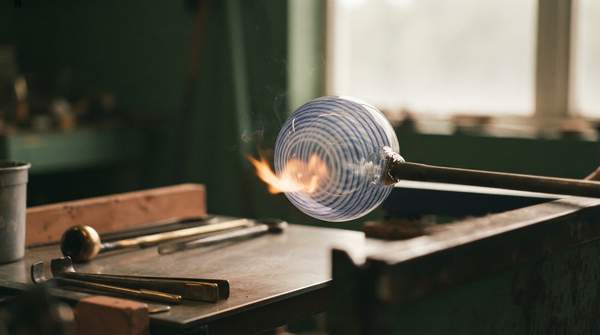
Every piece of hand-blown glass begins the same way—with molten glass gathered on a blowpipe and a maker's breath—but it divides into two fundamental techniques that produce strikingly different objects. Free-blowing shapes glass with heat, gravity, and simple hand tools, yielding unique, artist-driven forms in which no two pieces are identical. Mold-blowing inflates the glass inside a hollow mold, producing consistent shapes and patterns that can be repeated across a series. Understanding which method produced a piece tells a collector or designer almost everything about its character: its individuality, its repeatability, and how it will behave in a room.
Understanding Hand-Blown Glass: Free-Blowing vs. Mold-Blowing
The distinction between the two techniques is best understood at the moment of shaping. In free-blowing, there is no mold to define the outline, so the glassblower relies on breath, heat, and handheld tools to coax the material into form. Because nothing constrains the glass except the maker's judgment, every piece carries the small variations of the hand that made it. The studio Lonca describes this vividly: in its Flow series, each tall vessel is shaped dynamically by heat, gravity, and the glassblower's hand, allowing the glass to fall and stretch before being stopped. This ensures that no two pieces are identical, as the shaping process itself is unique each time.
Mold-blowing works differently. As the Maui studio Moana Glass explains, the artist gathers molten glass and blows air into it while it sits inside a hollow mold; the glass expands until it fits the mold's walls perfectly, creating consistent shapes and patterns. This allows uniform production of cups, bottles, jars, and structured designs. The two methods therefore represent a genuine trade-off: free-blowing maximizes individuality and artistic expression, while mold-blowing delivers efficiency, symmetry, and repeatable design. Neither is inherently superior—the choice depends on what the piece is for.
Free-Blowing: The Art of Organic Form
Freehand-blown glass carries great artistic value precisely because no two items are ever identical, as Moana Glass notes. Each piece reflects the artist's skill, rhythm, and creativity, which makes the technique ideal for collectors and designers who value uniqueness. The resulting forms are organic rather than geometric: walls taper unevenly, lips curve slightly differently from piece to piece, and the silhouette records the decisions made in the heat of the moment.
This is one of the oldest and most artistic glassblowing techniques, and its aesthetic signature is variation. Small differences in size, color, and shape are characteristic of this method—not flaws, but the visible trace of a person working with a material that never behaves exactly the same way twice. For a collector, that means a free-blown vessel is genuinely singular; for a designer, it means a free-blown piece brings an unrepeatable gesture into an interior, a form that could not be ordered again even by the artist who made it. The method emphasizes the artistic and unique nature of each creation, which is why free-blown work tends to anchor a composition rather than repeat across it.
Mold-Blowing: Precision and Pattern
Mold-blowing trades some of that spontaneity for control. Because the glass expands until it fits the mold's walls, the technique offers greater command over symmetry, pattern, and size, allowing consistent and replicable designs. Moana Glass notes that this process allows for uniform production of cups, bottles, jars, and structured designs—objects where a designer might want a matched set or a precise repeated motif.
The technique became common after the invention of the blowpipe mold in ancient Rome, and it remains in use today in both industrial manufacturing and art studios. That dual life is worth remembering when evaluating a piece: a mold-blown object from an art studio still bears the marks of a hand at the blowpipe, even when its outline is disciplined by a mold. While consistent, handcrafted mold-blown pieces retain a unique character compared to industrial manufacturing. For interiors, mold-blowing suits handcrafted lighting pieces and tableware where uniformity and specific forms are desired—a row of pendants, a set of vessels—while still carrying the warmth of the handmade. Where free-blowing showcases individuality and craftsmanship, mold-blown glass, as Moana Glass puts it, showcases efficiency.
Comparative Guide to Hand-Blown Glass Techniques
The table below compares the two techniques across process, resulting form, and typical application, so you can match a piece's likely production method to your purpose—collecting a singular object or specifying a consistent series.
| Technique | Process | Resulting Form (Uniqueness vs. Consistency) | Typical Application |
|---|---|---|---|
| Free-Blowing | Molten glass is shaped using a blowpipe, breath, heat, and simple hand tools, allowing direct artistic manipulation. One of the oldest and most artistic glassblowing techniques. | Unique, organic, artist-driven shapes with inherent subtle variations—no two pieces are identical. Small differences in size, color, and shape are characteristic of this method. | One-of-a-kind art pieces where individual expression and unique forms are prioritized. This method emphasizes the artistic and unique nature of each creation. |
| Mold-Blowing | Molten glass is blown into a pre-formed hollow mold that guides the shape and pattern of the final object. The technique became common after the invention of the blowpipe mold in ancient Rome. | Greater control over symmetry, pattern, and size, allowing consistent, replicable designs. While consistent, handcrafted mold-blown pieces still retain a unique character compared to industrial manufacturing. | Consistent designs, patterned objects, and handcrafted lighting pieces where uniformity and specific forms are desired. Used in both industrial manufacturing and art studios. |
Read together, the rows give you a working diagnostic: an irregular, unrepeatable silhouette points to free-blowing; a crisp, repeated pattern or a matched set points to a mold. That single inference already tells you much of a piece's story before you turn it over.
Identifying Authentic Hand-Blown Glass
Handmade glass and machine-made glass can look similar in a photograph, but in the hand they are very different objects, as Lonca observes. The first cue is small differences between pieces: two hand-blown pieces from the same series will be close in size, color, and shape, but never identical. Slight changes in height, wall thickness, or the curve of a lip are the marks of a person, not a defect.
The second cue is color that changes with thickness. In hand-blown glass, color often deepens where the wall is thicker and lightens where it thins, so the tone shifts as light passes through it—a living quality that also gives designers a way to modulate light in a room. Third, look for tiny bubbles: very small bubbles, called seeds, can be trapped in the glass during gathering and shaping, and in handmade glass they are simply part of the material. Fourth, turn the piece over.
The base of a hand-blown object provides insight into how it was held and finished at the furnace, with a carefully finished base often indicating quality studio work. Finally, the Imagine Museum advises viewing blown glass for signs of motion, airflow, and balance—how curves stretch and how color moves through the form. These variations are inherent to the handmade process and contribute to a piece's individual character, but they do not imply a lack of skill or quality.
Selecting Hand-Blown Glass for Your Space
To effectively select hand-blown glass, evaluate pieces based on their production technique—free-blown for unique forms, mold-blown for consistent patterns—and on the visual cues of craftsmanship described above, then consider how their physical properties, such as thickness-shifting color and textured surfaces, will manipulate light and mood in your interior. A free-blown vessel rewards a place where its singularity can be seen; a mold-blown series rewards repetition and rhythm across a table or a run of pendants. The measurable indicator of success is simple: the reader will confidently articulate the differences between free-blown and mold-blown glass and identify handmade characteristics when viewing artisanal glass pieces. When you can name the technique from the object itself—reading seeds, finished bases, and the sway of an organic curve—you are no longer buying glass; you are reading it.
Sources
- What Are the Two Types of Glassblowing? A Beginner’s Guide — Moana Glass By Ryan Staub
- Blown Glass Techniques: Free-Blowing, Incalmo and More — Lonca Studio