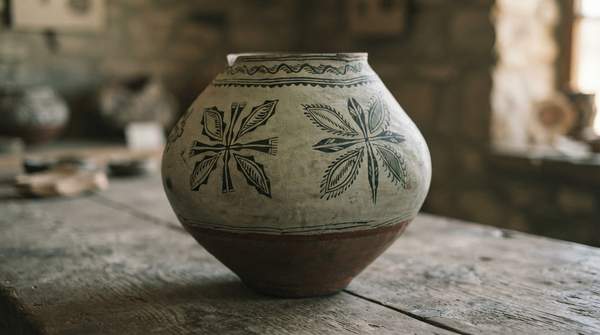
Two of America's most distinctive folk pottery traditions grew from opposite corners of the country, and they could hardly be more different in method and meaning. In the historic South, immigrant potters drew on local earthy clays and high-temperature kilns to produce alkaline-glazed stoneware churns, jugs, and pitchers built for hard use. In the Southwest, Pueblo potters in New Mexico carried forward a thousand-year-old practice of hand-coiling vessels without a wheel, polishing them with river stones, and firing them outdoors with organic fuels. Understanding the materials, construction, and firing choices behind each tradition is the surest way to tell one from the other.
Southern US Alkaline-Glazed Stoneware: Origins and Characteristics
Southern pottery was born of settlement. According to a Pebble Hill pottery booklet from Auburn University's College of Liberal Arts, the pieces made in the historic South reflect "migration and technological change affecting the people who settled the South," and their makers "were artisans who worked in a family-based folk tradition in communities where clay suitable for pottery production could be found." The pottery made and used in the historic South was, the same account notes, different from that of American Indian and West African traditions that preceded and surrounded it.
The craft's most durable technical signature was the alkaline glaze, developed in the South Carolina backcountry in the early 1800s, with salt and ash glazes also common in the region. Auburn's account describes stoneware firing at 2100 to 2500 degrees Fahrenheit, temperatures at which "not only the glaze melted but silica within the body of the vessel fused," making it waterproof and ideal for canning. That vitrified hardness produced the durability needed for frequently handled forms such as chamber pots, smoking pipes, and churns.
The salt-glazing tradition itself arrived with migrating potters from the Upland South, the North, or directly from Europe through southern ports. Forms remained utilitarian: churns, jugs, crocks, bowls, and pitchers, turned on the potter's wheel, with an emphasis on form and subtle ornamentation over decoration. A New Mexico Department of Cultural Affairs press release on Southern pottery illustrates this lineage in recent decades, listing wood-fired alkaline-glazed jars, face jugs by Burlon Craig, Lanier Meaders, and Wayne Hewell, and syrup jugs and one-gallon pitchers by potters including Vernon Owens and the Hewell and Crocker families.