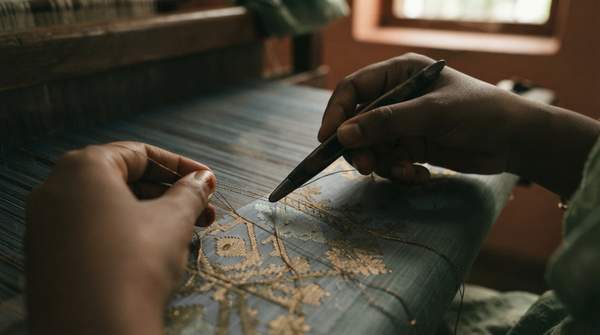
Jamdani is a traditional hand-loom weaving technique from Bengal—today's Bangladesh and parts of India—in which intricate motifs are created directly on the loom using a discontinuous supplementary weft, rather than stitched onto finished cloth. The result is a fine, sheer cotton fabric whose floral and geometric patterns appear to float within it, a quality that led UNESCO to inscribe the traditional art of Jamdani weaving on its Representative List of the Intangible Cultural Heritage of Humanity in 2013. Understanding why a single sari can take so long to complete begins with the loom itself, where two weavers work side by side building fabric and ornament at the same time.
The Intricate Art of Jamdani Weaving: A Legacy of Bengal
The name itself carries the craft's history. According to a Google Arts & Culture feature by Dr. Saifur Rashid presented with ICHCAP, "Jamdani" derives from the Persian word "jam," meaning floral, and "Dani," a vase or container, named after the decorative floral patterns found in Dhakai muslin. The fabric is woven in cotton, and its celebrated fineness belongs to the same textile family as the famed muslins of Dhaka.
What distinguishes Jamdani from other figured textiles is not the richness of its motifs alone but the way those motifs come into being. As the encyclopedic record of the craft describes, whether figured or flowered, Jamdani is a woven cotton fabric in which the artistic motifs are produced by a non-structural weft, added in addition to the standard weft that holds the warp threads together. The patterns are therefore integral to the cloth—interlaced thread by thread—rather than applied to its surface afterward.