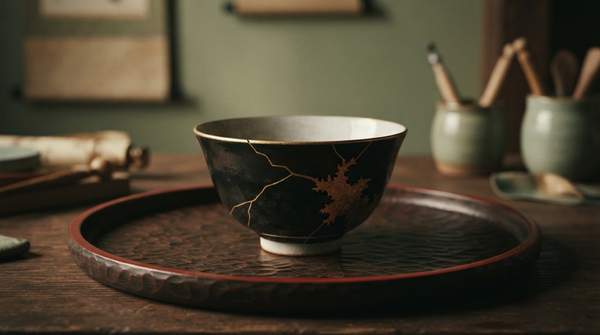
Kintsugi is a Japanese craft in which broken pottery is rejoined with lacquer and powdered gold, silver, or platinum — and the repair is deliberately left visible. Where conventional restoration works to erase the evidence of damage, kintsugi treats breakage as part of an object's history, to be honored rather than hidden. The name itself means "golden joinery," or, as the BBC renders it, "to join with gold," and the practice is generally traced to the late 15th century. Its philosophical engine is wabi-sabi, the Japanese aesthetic that finds beauty in imperfection, impermanence, and incompleteness.
Kintsugi: The Art of Embracing Imperfection
The craft's most striking feature is not the gold but the refusal to disguise the break. A mended bowl does not return to its "original" state; it carries golden veins along its fracture lines, and those seams become part of what the object is. Writers at The Kintsugi Labo, a Japanese studio journal, describe the restored vessel as "not less but more: a record of survival made visible."
This inversion of ordinary repair logic is what gives kintsugi its cultural weight. A travel guide published by Veltra observes that the craft "doesn't merely fix what's broken; it celebrates the break itself, turning scars into golden veins that tell stories of resilience, acceptance, and the sublime beauty found in imperfection." The repair, in other words, is not a return to wholeness but an acknowledgment that the object survived something — and that the survival is worth displaying.
That stance carries a quiet ethical charge. In an age of mass production and quick disposal, as the BBC's feature on the tradition notes, choosing to mend rather than discard becomes a lesson in sustainability as much as aesthetics. The gilded crack argues against the throwaway reflex.
The Philosophical Heart: Wabi-Sabi and Kintsugi
Kintsugi is widely described as an extension of wabi-sabi, the aesthetic philosophy that, in the words of one encyclopedic summary, embraces "the flawed or imperfect." The two halves of the term carry distinct shades: as the Veltra guide explains, "wabi" conveys rustic simplicity and understated elegance, while "sabi" reflects the beauty that emerges with age and the passage of time. Together they celebrate the marks of wear, the weathering of surfaces, and the gentle decay that speaks to life's transient nature.
Kintsugi gives this abstract aesthetic a physical form. A hairline of gold along a fracture is imperfection made precious — the philosophy rendered in material. The Kintsugi Labo adds that the idea is rooted in wabi-sabi and Zen, and that it has come to stand for resilience in life as well as in ceramics. The broken bowl becomes an argument: that flaws and missteps are not failures to be concealed but events to be incorporated.
There is also a market dimension to this valuation. The traditional kintsugi studio Tsugu Tsugu notes that tea sets repaired with kintsugi remain very expensive today, and that kintsugi is regarded as increasing a vessel's value above what it had before it broke. The repair does not merely preserve worth; in this view, it creates it.