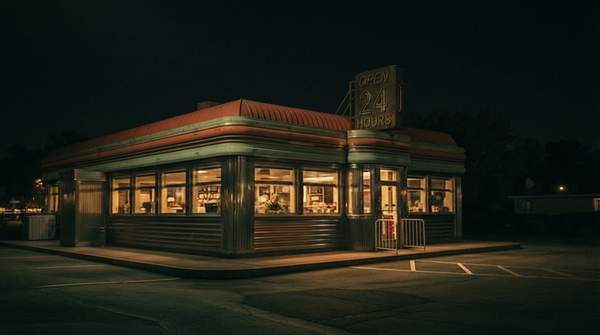
The American diner looks like a train car for a straightforward historical reason: it descended from one. The diner began as a horse-drawn lunch wagon in the nineteenth century, was pushed off the streets by city regulations, and was deliberately redesigned to evoke the electric railroad dining cars that were reshaping American travel. Builders then industrialized that look, mass-producing long, narrow, prefabricated buildings that could be shipped in pieces and assembled on site. The result was never merely a style — it was a lineage, with each form answering a practical pressure of its era.
The Mobile Origins: From Horse-Drawn Wagons to Stationary Lunch Cars
The story begins with mobility. In the early 1870s, a Providence printer named Walter Scott began hauling food and supplies onto a freight wagon, making it easy to move his business and seek out customers where they gathered. As one historical account of lunch wagons recounts, Scott's improvisation inspired a succession of entrepreneurs and launched what became a tradition of form-follows-function design coupled with commercial ingenuity.
These wagons primarily served evening patrons — local workers and men out for the night — though many later adopted daytime hours or operated around the clock, as one diner history notes. Their portability was both their virtue and their vulnerability. As the wagons multiplied, cities began to push back, restricting their hours or banning them outright. Regulation, more than any aesthetic ambition, forced the first great transformation in diner architecture.
The Railroad Influence: Why Diners Look Like Train Cars
When cities clamped down on street wagons, some operators sought permanent locations, and wagon builders quickly adapted by borrowing designs from railroad cars. In 1905, Worcester's T.H. Buckley Lunch Wagon Manufacturing and Catering Company rolled out a model mounted on low wheels — one that could be delivered from the factory and simply left in place, rather than hauled out each morning and returned each evening.
There was also a shrewd logic in the resemblance itself. As electric rail cars progressively replaced horse-drawn routes, the dining car offered both a way to skirt operating-hour restrictions and a more permanent setting. A few operators took the association literally: because old train and trolley cars fit the preconceived idea of what a diner should be, a handful were converted into restaurants outright. The long, narrow shape stuck because it worked — a compact linear space with a counter and a backbar mirrors the efficiency of a railroad dining car.
The Rise of Prefabricated Diners and Iconic Design Elements
What began as a workaround became an industry. The Worcester Lunch Car Company, once among the country's leading diner manufacturers, produced 651 diners between 1906 and 1961 — a run documented by GBH, whose reporting drew on the Worcester Historical Museum. Bill Wallace, the museum's executive director, described the earliest lunch wagons as "a little box on wheels" that looked "very much like train cars." Jerry O'Mahony is widely credited with creating and popularizing the traditional diner: long, narrow buildings deliberately reminiscent of a railroad car.
Prefabrication completed the evolution. By the 1940s, manufacturers had devised methods of building diners that could be shipped in pieces and assembled on site without compromising structural integrity. Inside, the equipment followed the same logic: steam tables, grills, refrigerators and exhaust hoods, all integrated with storage and prep areas in the "backbar" behind the counter. In the 1930s, the streamline aesthetic — with its appearance of movement and efficiency — swept American design, and diners absorbed it whole.
The Miss Lorraine Diner, built by the Worcester Lunch Car and Carriage Manufacturing Company in 1941, displays the hallmarks: a streamlined look, central door and monitor roof, finished with stainless steel, neon signage and Art Deco touches. From the mid-1960s, diner experts Brian Butko and Kevin Patrick note, design shifted toward what they call "Environmental style" — brick, stone, wood paneling, and Colonial or Mediterranean motifs.
The Diner's Architectural Journey: From Wagon to Icon
| Stage of Evolution | Typical Form | Key Features | Driving Factors |
|---|---|---|---|
| Early 19th–19th century origins | Horse-drawn lunch wagon | Mobile freight wagon fitted to serve food; basic service, mostly to evening patrons | Mobility let vendors move to find customers; Walter Scott's wagon is an early example |
| Late 19th – early 20th century | Stationary lunch car | Long, train-like shapes; some converted from old train and trolley cars; factory-delivered and left in place | City rules limited hours or banned wagons, pushing operators toward fixed locations and railroad-inspired designs |
| 1920s–1950s | Prefabricated "railroad" diner | Streamlined look, central doors, monitor or barrel roofs, skylight vents, stainless steel and neon | Mass production by firms like Worcester Lunch Car Company and Jerry O'Mahony; shipped in pieces for on-site assembly, enabling extensive food preparation in a compact linear space |
Read across its rows, the table shows that each transition was a response rather than a whim: regulation ended the wagon era, the electric railroad supplied both a model and an escape from restrictions, and factory fabrication turned the dining-car look into a repeatable, shippable product. The classic diner's features contributed directly to the train-car aesthetic that survives on most existing diners today.
More Than Just Food: The Diner as a Cultural Icon
The architecture carried meaning beyond its mechanics. Diners attract a wide spectrum of their local populations and are generally small businesses, which made them accessible gathering places across classes and shifts. Their menus absorbed the immigrant communities who ran them — Greek moussaka and pastitsio, Slavic blintzes, Jewish chicken soup with matzah balls, deli-style corned beef and pastrami sandwiches, bagels and lox — so the food itself became a general map of American ethnic contributions.
Artists and television noticed. Edward Hopper's 1942 painting Nighthawks distilled the haunting ambiance of an urban diner at night into one of the most recognized images in American art. On screen, the diner became a recurring stage: Alice was set in one, and a diner is often a regular feature of sitcoms like Seinfeld. The influence runs forward, too — chains such as Denny's have copied the 1950s diner look for nostalgic appeal, while Waffle House uses an interior layout derived from the diner. Even relocation has become part of the lore: Manhattan's Moondance Diner was shipped to Wyoming to make room for development.
Recognizing the Enduring Legacy of Diner Design
When you encounter an American diner, take a moment to read its architecture for its historical lineage: the wagon that had to move, the dining car it imitated, and the factory that shipped it in pieces. The presence of streamlined forms, stainless steel, a long, narrow layout, or a monitor or barrel roof indicates a direct link to the prefabricated "train car" aesthetic. Those features are the visible record of a building type that answered regulation with ingenuity and turned mobility into permanence — and, through Hopper's canvas and decades of sitcom sets, into an enduring symbol of American community.
Sources
- Where Did Diners Originate & Why they Look Like Train Cars? — Restaurantfurniture
- The History of Diner Cars & Lunch Wagons — ArtInRuins
- The History of the American Diner – Colony Diner & Restaurant — Colonydiner
- Diner - Wikipedia — EN
- Worcester Lunch Car Company - Wikipedia — EN
- Worcester was once a center for manufacturing pre-built diners — GBH