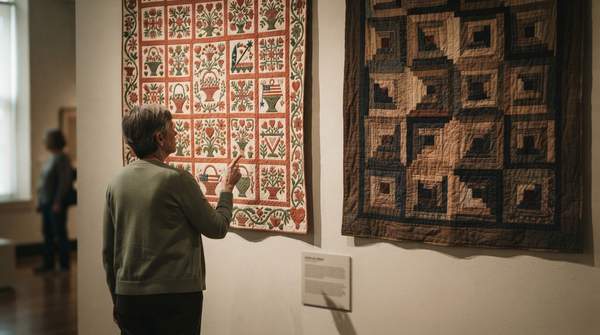
American quilts are rarely just bedding. Read closely, they function as historical documents: the fineness of a Baltimore Album quilt's silk appliqué announces a prosperous 19th-century city, while a "wheel" block stitched on a Nebraska homestead records the windmill that pumped water for livestock. Understanding how these styles diverged, in material, motif, and purpose, is the clearest way to see how American quilt patterns evolved as reflections of their time and place.
The Quilt as a Historical Document: An Introduction
The quilts preserved in museums and family collections carry evidence of the conditions under which they were made. A National Park Service historical account of the westward movement describes quilt making on the Great Plains as inseparable from daily survival: the windmill was so essential to homestead life that its wheel became a favorite pattern. When the United States entered World War I in 1917, the government requisitioned wool for commercial use and urged citizens to quilt with the slogan "Make Quilts—Save the Blankets for our Boys Over There," and the resulting utilitarian quilts earned the nickname "Liberty Quilts."
This is the interpretive key to the whole craft. The same art form that produced heirloom showpieces in Baltimore produced feedsack quilts on the Plains, not because the makers differed in skill, but because their resources, economies, and daily realities differed. Pattern names, fabric choices, and even the occasion of a quilt's making all encode information about who stitched it and why. Two regional traditions, separated by half a century and a continent, illustrate the range.
Baltimore Album Quilts: Urban Artistry and Social Expression
Baltimore Album quilts emerged in 19th-century Baltimore as an urban, communal art form. A humanities account of quilting in the Industrial Age describes members of the Baltimore Quilters Society meeting regularly to work on quilts and share ideas and techniques, with an emphasis on fine craftsmanship and attention to detail. Their quilts feature floral and geometric patterns meticulously appliquéd onto white or light-colored backgrounds, worked in silk, wool, and cotton, and embellished with embroidery, beading, and other decorative elements.
Crucially, each block was often a distinct composition. Many blocks carry the names of friends and family members along with important dates and events, so that the finished quilt reads almost like a signed album, which is precisely where the style takes its name. This practice made the quilt a social document as much as a decorative one: it recorded a community's relationships and milestones in fabric.
The account notes that these quilts were often made with high-quality materials such as silk and velvet, were highly prized by their owners, and were passed down as heirlooms, with many now held in museums and private collections. The Industrial Revolution made such refinement possible, expanding the range of available textiles in the 19th century. The same account situates these quilts within the lives of women in 19th-century Baltimore, reflecting the cultural and social influences of the time, and as evidence of the importance of quilt-making in American art history.
Great Plains Homestead Quilts: Utility and Symbolic Narratives
On the Great Plains, the craft's priorities inverted. The National Park Service account frames quilts as a necessity for homesteaders, stitched from available and often repurposed fabric. The clearest example is the "feedsack quilts" of the 1920s and 1930s, made by recycling the printed sacks that had held grain and seed; women saved and traded feedsacks to obtain the colors and patterns they wanted, turning packaging scarcity into a palette.
The motifs were drawn from immediate experience. The wheel pattern honored the windmill, whose importance to everyday homestead life made it a favorite. The Dresden Plate block, inspired by elaborately decorated porcelain produced in Dresden, Germany, was pieced from petal-shaped wedges and appliquéd to a square of fabric, evidence that even remote homesteads participated in wider design currents. Pattern names like "Barbed Wire Fence" translated the built landscape of the Plains directly into patchwork.
Plains quilting also carried a strong regional storytelling impulse. The International Quilt Museum notes that the mixing of people on the Great Plains was at times violent, with figures like Sitting Bull, George Armstrong Custer, Calamity Jane, and Buffalo Bill Cody symbolizing the region's history and legends. Into the early 20th century, the museum traces how the "Covered Wagon States" pattern appeared as a syndicated series in the Omaha World-Herald during 1939 and 1940 and in other newspapers nationwide. Rather than the colonial past celebrated by much of the Colonial Revival movement, these blocks depicted a western American past, offering the heartland its own regional variation of Revival design.
Comparing Regional American Quilting Styles
Placing the two traditions side by side shows how completely environment and social condition reshaped a single craft. The table below juxtaposes the materials, motifs, and social functions of urban 19th-century Baltimore quilts against Plains quilts spanning the homestead era through the early 20th century.
| Dimension | Baltimore Album Quilts | Great Plains Homestead Quilts |
|---|---|---|
| Historical Period | 19th-century urban Baltimore | Homestead era through early 20th century; feedsack quilts of the 1920s–30s; "Covered Wagon States" syndicated 1939–1940 |
| Typical Materials | High-quality silk, wool, cotton, and velvet; embellished with embroidery and beading | Utilitarian, available, and repurposed fabrics, including recycled grain and seed feedsacks |
| Common Motifs/Patterns | Meticulously appliquéd floral and geometric patterns, often a unique design per block, with names and dates worked in | The "wheel" (windmill), Dresden Plate, "Barbed Wire Fence," and western imagery from the "Covered Wagon States" series |
| Primary Purpose/Social Context | Communal artistry and social connection through quilting societies; prized heirlooms recording friends, family, and events | Warmth and survival on the homestead; creative outlet; patriotic expression such as WWI "Liberty Quilts"; regional storytelling of a western past |
The comparison yields a clear finding: where Baltimore's quilters had the leisure and materials to compete in artistry, Plains quilters worked under scarcity and let necessity dictate form, yet both traditions used pattern to document their worlds. A museum label alone may not tell you which tradition you are looking at, but the fabric does: silk and velvet signal one economy, feedsack prints another.
Patriotism and Quilts: Threads of National Identity
Beyond any single region, national events repeatedly redefined what quilts were for. The World War I episode is the sharpest documented case: with wool requisitioned for commercial use, the government actively promoted home quilt making under the slogan "Make Quilts—Save the Blankets for our Boys Over There." The utilitarian quilts that resulted became known as "Liberty Quilts," fusing thrift with loyalty at the moment the United States entered the war in 1917.
The African-American quilting tradition forms another essential thread of this broader story. An account of Gee's Bend quilts describes their history as "a rich and intricate subject that bridges art, craftsmanship, and cultural storytelling," noting that generations of skilled hands preserved and evolved the tradition within a single community, where the craft's roots, community impact, and continued relevance in design and heritage remain inseparable. That framing, quilting as cultural storytelling carried across generations, applies to the whole American tradition, though the Plains and Baltimore examples in this article remain illustrative rather than a comprehensive survey.
Patriotic and commemorative impulses continued into the 20th century as well. The Colonial Revival movement reached the Plains in regionalized form, with newspaper-syndicated blocks celebrating a western rather than colonial past, proof that even nostalgic movements were adapted to local identity.
Quilts as Enduring Cultural Narratives
To fully appreciate American quilting, one must recognize that each stitch and pattern is a deliberate choice reflecting the maker's environment, resources, and cultural identity. That is the decision this article equips you to make: treat every historical quilt as evidence, and read its fabric, motifs, and occasion before admiring its beauty.
The measure of that understanding is straightforward. The reader will be able to identify and articulate the historical and cultural context behind at least two distinct American quilting styles when encountering them in museums or historical texts. The next time you stand before a display case, check the fundamentals first, the material, the block design, the era, and ask what world the maker was stitching into it.
Sources
- Npshistory
- 6.6: The Art of Quilting (1800-1900 CE) — Humanities LibreTexts
- Perfecting the Past: Colonial Revival Quilts — Internationalquiltmuseum
- Gees Bend Quilts History — oregoned.org