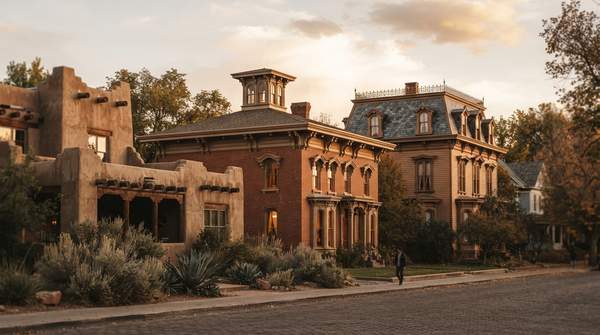
Every historic American building announces itself, if you know where to look—and the fastest place to look is the roof. Pueblo Revival hides its roof behind a soft-edged parapet and lets round wooden beams poke through the wall. Italianate flares outward in wide, bracket-supported eaves. Second Empire stacks a double-pitched mansard roof atop the façade like a boxy Parisian hat. This guide compares those three styles, tracing their origins and pairing their defining features side by side so you can tell them apart at a glance.
Introduction: Understanding American Architectural Styles
These three styles emerged from very different impulses in different corners of the country. Pueblo Revival reached back to the Indigenous adobe architecture of the Southwest; Italianate imported the rambling villas of the Italian countryside through English pattern books; Second Empire borrowed wholesale from the Paris of Napoleon III. What unites them is the revival spirit of nineteenth-century design, when, as Omaha's historic preservation office describes it, architects "drew inspiration from past design traditions and sought to revive or reinterpret them in contemporary contexts."
Each style solved a different problem for its era—responding to climate, expressing romantic ideals, or signaling modernity—and each left behind a distinctive visual signature. The sections below trace each style's look and lineage, and a comparison table distills their differences into a quick reference.